
Data centre labels start with reliable figures
Presented by KAI, the Clear Decisions AI assistant for data centres. KAI stands for Kaizen and AI: continuous improvement, with the evidence to show for it.
If your data centre is in the EU and has 500 kW or more of installed IT power demand, it is due to carry a public label from August 2027: a class from A to G for energy and for water, built from the figures you report next May, with your name on it. Germany already shows what a public number looks like. Here is what has happened, what the label is built from, and what to check now.
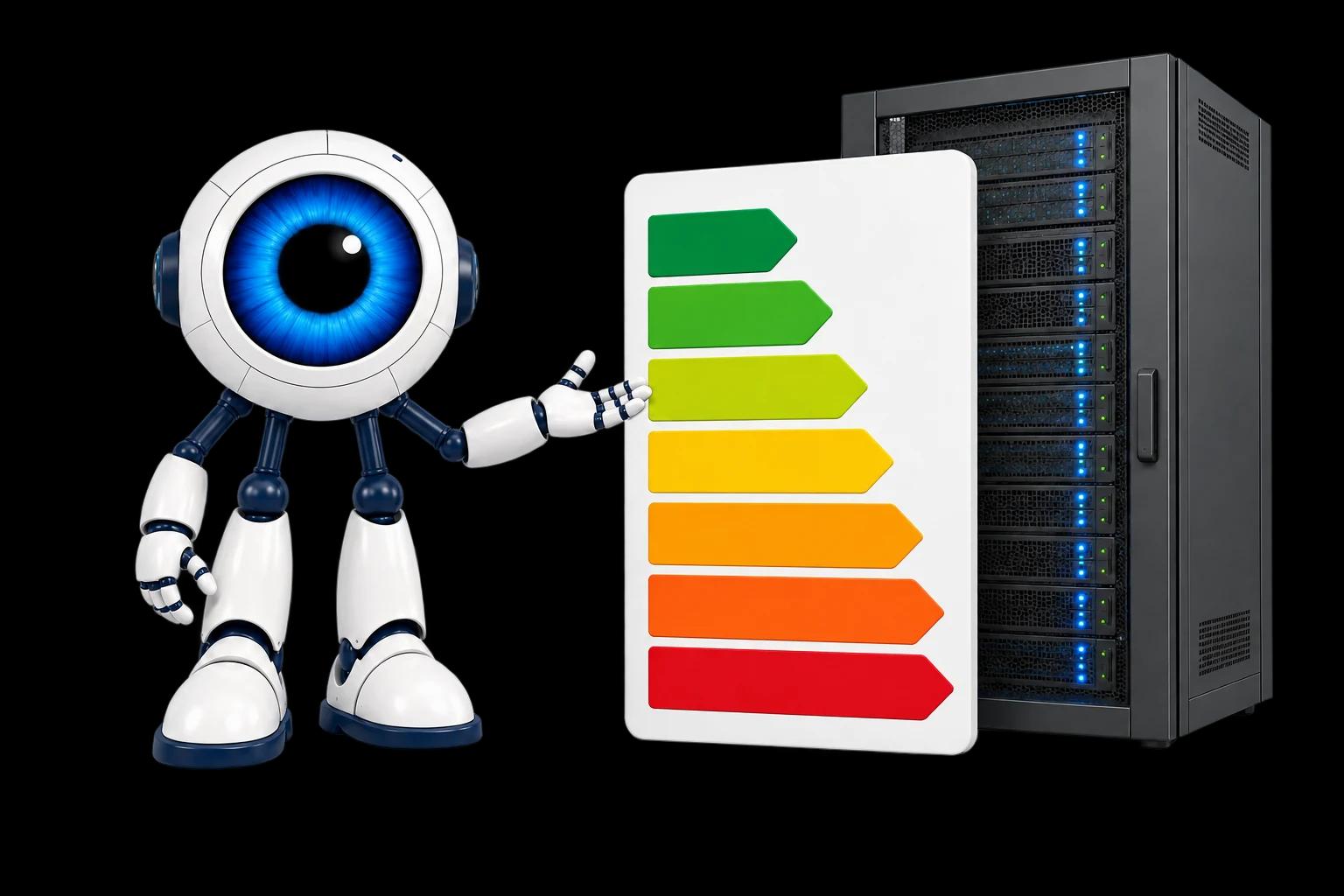
Where German reported PUE sits against that scale
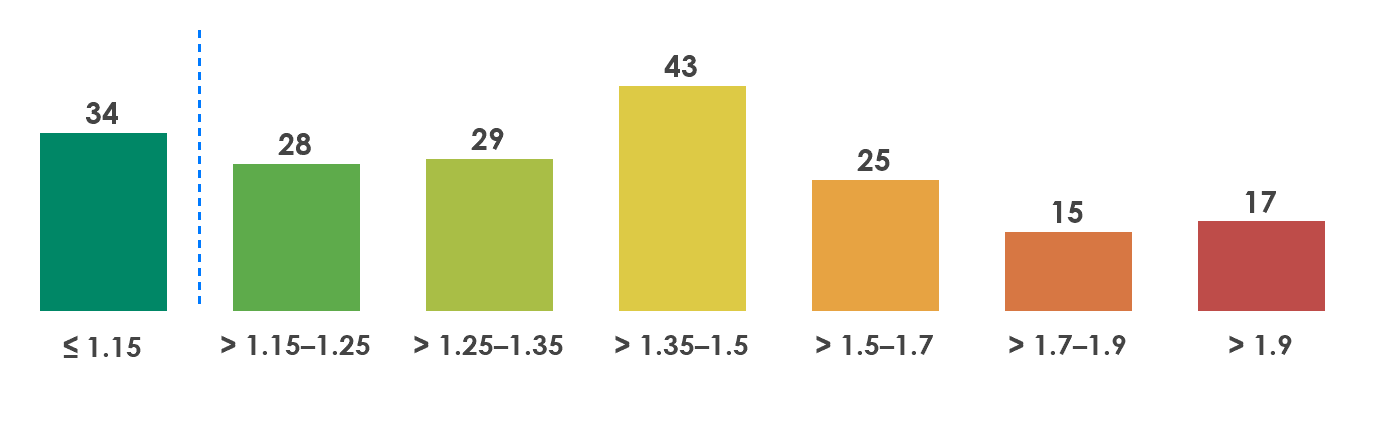
Reported 2025 PUE of 191 data centres whose operators chose to publish on the portal, at 500 kW IT connected load and above, excluding 14 entries where IT load equals or exceeds total load. Reported under the 2024 rules, which put IT energy at the UPS for sites that have one. The adopted rule moves it to the rack or PDU, so figures like these are likely to rise. Annex I bands shown for scale; dashed line marks the Class A boundary. Median 1.38.
What’s changing
On 14 August 2026 Germany's public data centre register went online, with figures for 2025. Operators of data centres from 300 kW non-redundant electrical connected load must report every year by 31 March and publish specified indicators. The portal is one way to publish, and 165 operators chose it for 319 data centres. Each of those has its own entry, with PUE and WUE among the published indicators. Everything else appears only in the aggregate statistics.
On 21 September 2026 the European Commission adopted the regulation establishing the EU rating scheme for data centres; on 6 October the European Parliament extended its scrutiny by two months. If it enters into force as adopted, every data centre with 500 kW or more of installed IT power demand would get a public label by 15 August 2027, built from 2026 figures reported by 15 May 2027, showing a class from A to G for energy and for water, not the values.
Why it matters today
The label would show a class, not a number, but the number sets the class. An error that moves PUE or WUE across a band boundary moves the label. A change of measurement point can do the same without any error: under the adopted text, a site that reported IT energy at the UPS output will report a higher PUE, which can move it into a different class. Reported data already has quality problems. A study for the Commission screened the 770 data centres in the first EU reporting round, covering 2023. It judged 70.1 per cent reliable, meaning their figures were consistent with each other across the reported metrics. The rest were not judged reliable.
The adopted act adds a reporting field asking whether a qualified or accredited third party validates how you measure and report, distinguishing that from self-certification, and puts certification or auditing of reported data on the agenda for its first review, due by the end of 2028.
EU reporting year 2025
data centres · 11 Member States
total energy consumption
PUE · weighted average
WUE · weighted average
The European database on data centres, as shown on the Commission's dashboard, last updated 25 September 2026 and checked 4 November 2026. Calendar year 2025, from the 11 Member States that had delivered it at the time of checking; the 2024 year now shows 22, so the 2025 figures will fill in. Reported under the 2024 measurement rules.
WHAT TO DO NOW
Put every meter on your single-line diagram and mark which ones feed total energy, IT energy and freshwater, and where IT energy is measured: UPS output, PDU or rack.
Why the position of the IT meter now matters is explained in Ask KAI below.
INTEGRATE. Record what each meter reads, in which unit, over which period.
VERIFY. Check last year's figures back to meter and period.
PROVE. For every figure you calculate, keep which meter, which period, which unit and what was estimated, so someone else can reach the same number next year. Keep the record of your measurement points and devices for at least 10 years.
Proof in practice
Ask KAI
“We measure IT energy at the UPS output. Does that still count?”
Not under the new rules. The 2024 scheme asks for IT energy at every UPS connected to IT equipment, category 1 under EN 50600-4-2. Sites without a UPS, such as DC data centres, have more freedom: they can measure at the PDU, follow category 2, or use a measurement point they specify themselves. The adopted text replaces that: IT energy is measured at the point of connection to the racks, the power strip or rack plug, category 3, and only where that is not possible at the PDU, category 2. UPS output is no longer one of the listed points.
Moving the meter downstream leaves the losses between the UPS and the rack, in PDUs and cabling, outside the IT figure, so the same site reports a lower IT energy and a higher PUE than before. The same IT energy figure sits in the denominator of WUE, so water efficiency moves as well.
If the scheme enters into force as adopted, it is worth looking again at your metering set-up and at how you read from the system and calculate PUE today. You may need to recalculate it for your EED report next May. I can help with that.
Sources
- BAFA, public RZReg launch notice, 14 August 2026; Section 13 EnEfG; BfEE data guidance, v1.1.
- C(2026) 3472 final, 21 September 2026; Register of Delegated Acts, entry 2983; Annex I rating bands.
- AIT, Borderstep and EY for DG Energy, Assessment of the energy performance and sustainability of data centres in EU, first technical report (2025). Not the Commission’s official position.
- Delegated Regulation (EU) 2024/1364, Annex II, point 1(e); C(2026) 3472, Annex III, point (2)(a)(3), replacing Annex II, point 1(e) of Delegated Regulation (EU) 2024/1364.
- European database on data centres, Commission dashboard; updated 25 September 2026, checked 4 November 2026.