Govern the compliance you run.
Continuous compliance. Managed risk.
Across a data centre's operation, as a running system rather than a project before each audit.

Three questions developers and operators ask
Which risks are we carrying today, and which controls cover them?
Could we pass an audit tomorrow without weeks of preparation?
How do we take on a new standard without starting from scratch?
Standards and frameworks covered today
ISO standards
EU and UK law
- NIS2 · EU Network and Information Security Directive
- DORA · EU Digital Operational Resilience Act
- UK NIS — CAF · NIS Regulations 2018, assessed against NCSC Cyber Assessment Framework v4.0, with Cyber Security and Resilience Bill duties
- EU environmental permitting · EIA, IED and MCPD consent conditions
Industry codes and frameworks
- EU Code of Conduct for Data Centre Energy Efficiency · Participant and best-practice register
- SOC 2 · AICPA Trust Services Criteria
- PCI DSS · Payment card data security
In the order you actually work.
Plan
Scope your standards and sites, decide what applies, and hold your risk register with risks linked to the controls that treat them.
Do
Policies, procedures and evidence in a controlled document vault with role-based access, and controls preloaded for your business.
Check
Kai checks what each requirement asks, reads your documents against it, and writes the finding with source citations: met, or a major or minor non-conformity, with a proposed fix.
Act
Corrective actions, non-conformity tracking, management review and the board summary. Your team signs off at each step.
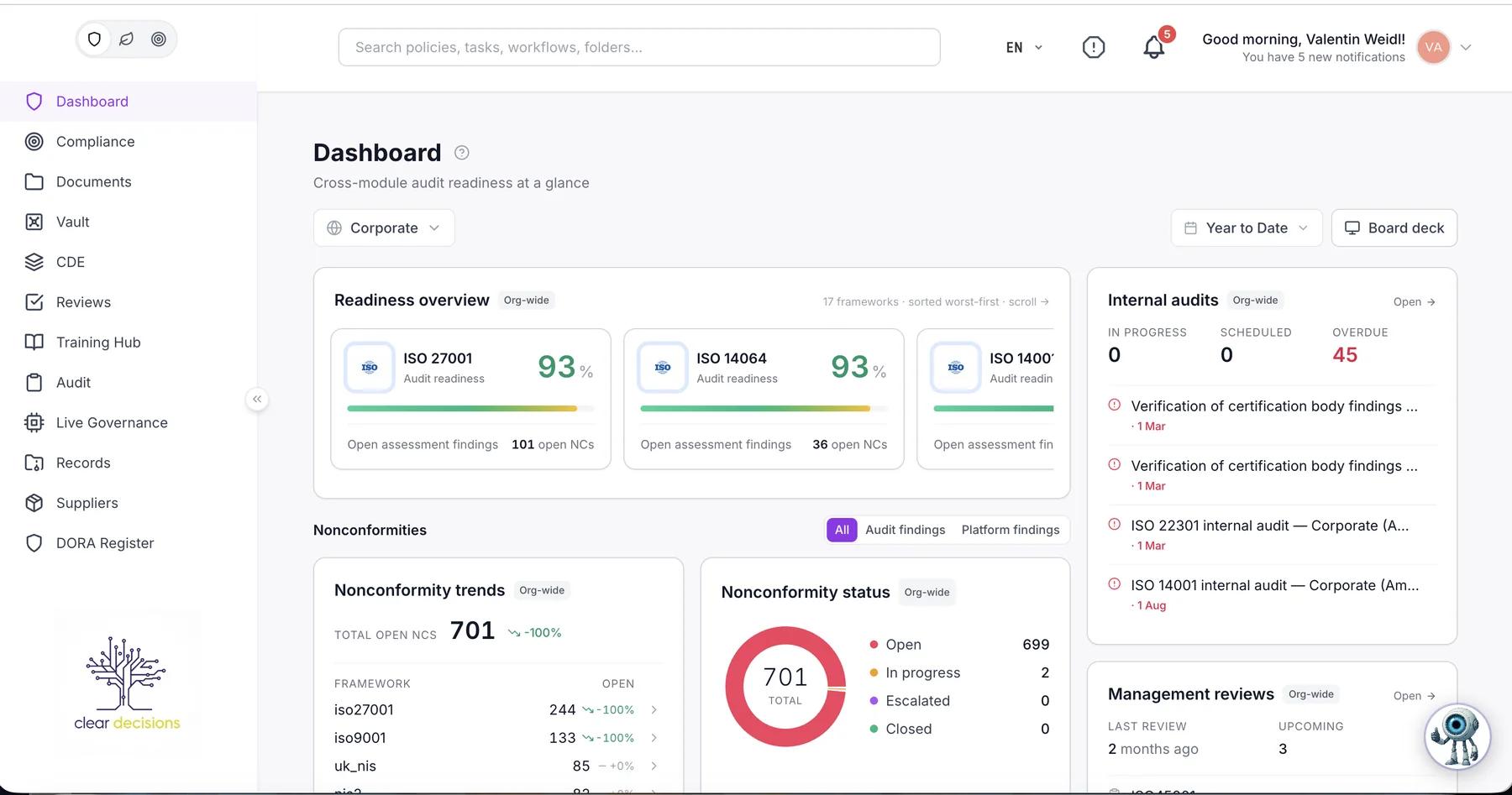
The artefact, not the dashboard.
Nobody buys a dashboard. They buy the thing that goes in front of an auditor, a customer or a board.
- Evidence bundle, per audit and per clause
- Management review pack and board summary
- Training built from your own policies, in your roles and terminology
- Competence matrix and training record
- The Compliance Bill of Materials: obligations, controls, owners, documents, data and audit history in one exportable record
Evidence mapped once, reused by the next standard.
Every control carries its own justification, owner, implementation state and evidence, and each of those is counted separately, so "we have a control" and "we can prove it" stop being the same claim. Control-to-risk traceability runs both ways: risks point at the controls that treat them, and controls point back at the evidence.
- Start from a baseline drawn from a real data centre operator’s audited control set
- Import your existing Statement of Applicability, or auto-map controls from your risk register
- Carry your ISO 27001 statements onto the UK NIS or NIS2 control set rather than rewriting them
- An exclusion has to carry a defensible justification — restating "not applicable" is not one
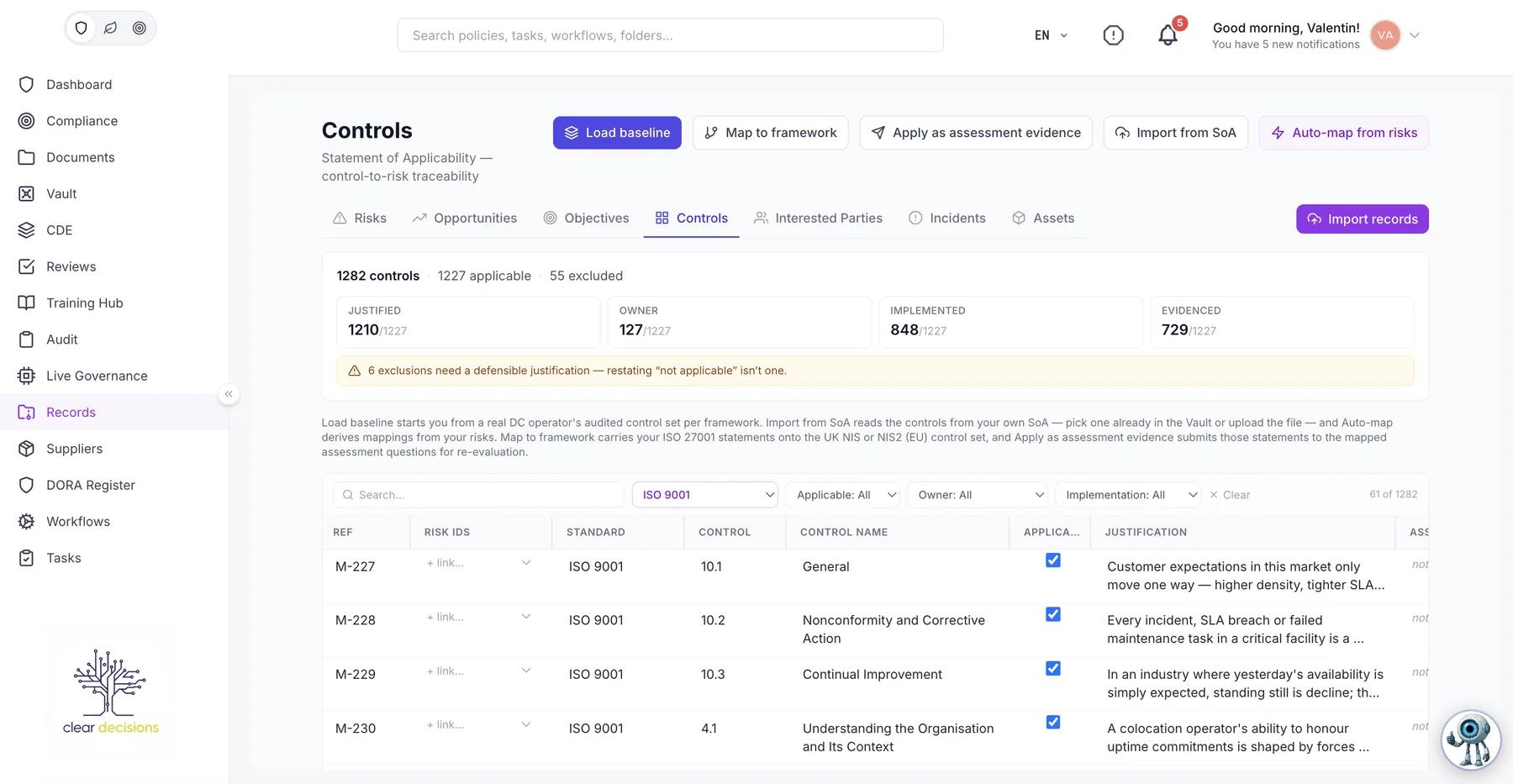
Ask Kai, inside Compliance and Risk.

Three people, three different fears.
The compliance owner
Holds the controls together with spreadsheets and personal memory, and carries the exposure when a finding lands. Wants evidence that survives a challenge.
The operator
Measures audit week in engineer-days spent gathering evidence instead of running the floor. Wants the time back.
The signer
Sees compliance as a cost line and a tender risk. Cares that questionnaires stop losing deals.
See where you stand before you talk to us.
What each standard actually requires of a data centre, what auditors ask for, and the instruments each answer rests on. Free, dated, and reviewed by a named lawyer.
Read the standards references“A really useful AI compliance tool for data centres.”

Kai interprets. People verify.
Kai explains what a regulation means and proposes the fix. Your team decides. The evidence behind every finding carries a source and a date, because a compliance record that reads as machine-generated is worth nothing in an audit.